
Blog
What Insurers Expect in a Statement of Values for Lab Equipment Insurance
A Statement of Values tells your insurer what your lab equipment is worth, and stale self-reported figures are the leading cause of coinsurance penalties at claim time. This guide explains what insurers expect on the equipment line of an SOV and how appraised replacement cost keeps that number defensible.
Every property insurance renewal for a lab or biotech facility comes with the same request from the broker: submit a Statement of Values. For a facility running analytical instruments, ultra-low freezers, incubators, and bioreactors, that single document determines how much of a loss your policy actually pays. This guide covers what insurers expect on the equipment line of an SOV, why self-reported numbers go stale, and how an appraised replacement cost keeps your lab equipment insurance coverage defensible at renewal.
What a Statement of Values Is and Why Insurers Ask for One at Renewal
A Statement of Values (SOV) is a structured report the insured submits listing every insured property, its location, and its insurable value under a defined valuation basis such as replacement cost or actual cash value. Insurers use it to set property limits, apply coinsurance, and price premiums, and it becomes especially important for facilities with multiple locations or high-value equipment schedules, as described by Insuranceopedia's definition of a Statement of Values.
Most carriers and brokers rely on a version of the standardized ACORD 139 Statement of Values form, which requires a separate line for each building or location, the building or contents type, the applicable coinsurance clause, the valuation basis, and an estimated replacement cost. For a lab, that means your analytical instruments, cold-chain units, and fixed equipment typically land under a "machinery" or "equipment" column rather than a single lump-sum contents figure.
Insurers request an updated SOV at renewal because the values on file directly set your coverage limits and your premium. A facility that has added a new mass spectrometer, a bioreactor skid, or a bank of -80 freezers since the last renewal has changed its risk profile, and the insurer needs current numbers to price that risk accurately.
The COPE and Equipment Data Fields Your SOV Needs to Include
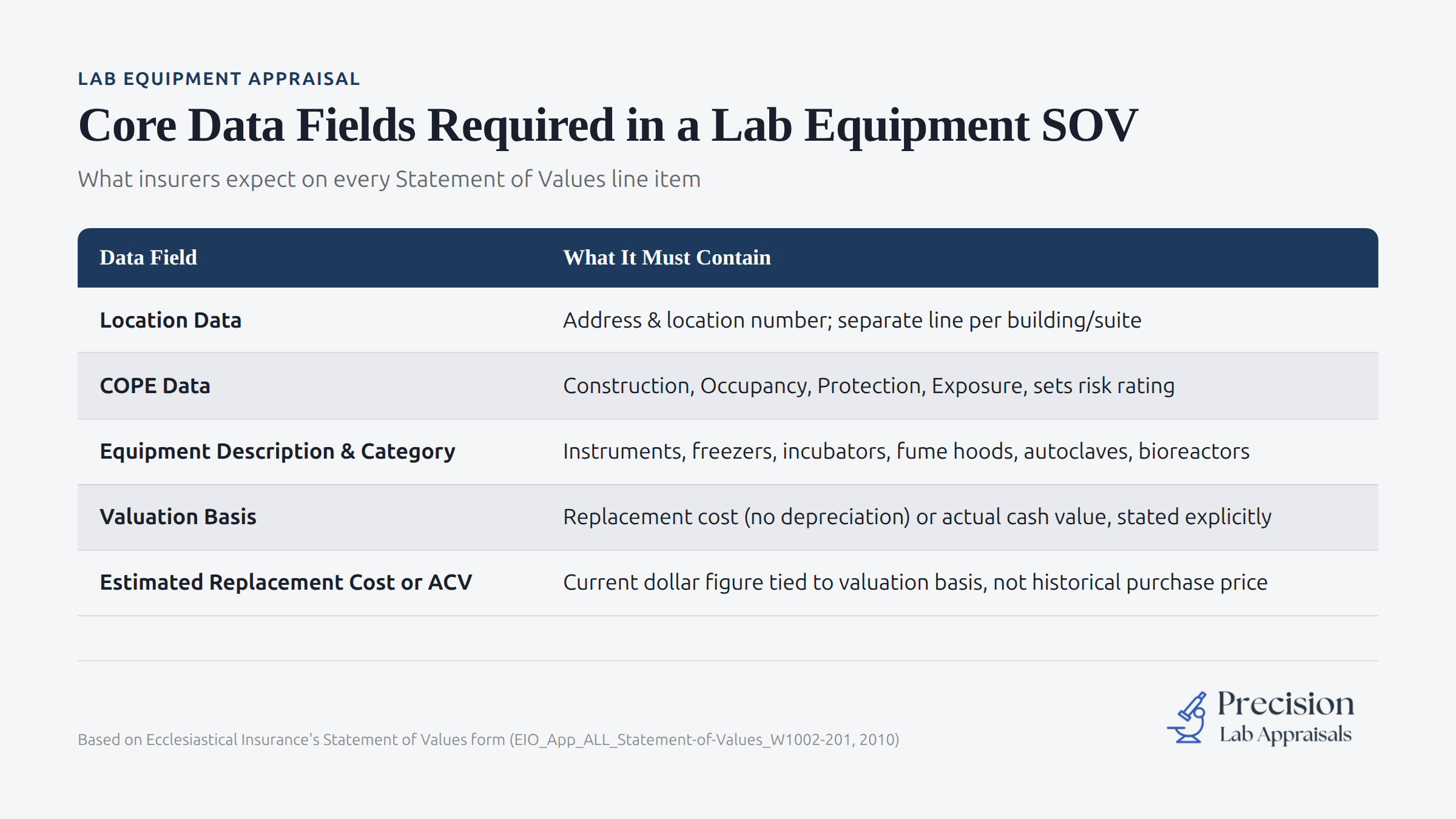
Insurers expect a minimum, structured data set on every SOV line, not a rough estimate. Beyond the dollar figure, they want to know what the equipment is, where it sits, and how the value was determined.
For lab and biotech facilities, that typically means gathering the following before you complete the form:
- Physical address and location number: Each building or suite gets its own line, since coinsurance and limits are applied per location.
- COPE data for the building: Construction type, occupancy, protection (sprinklers, fire suppression), and exposure, because these factors affect the risk rating for the equipment housed inside.
- Equipment description and category: Analytical instruments, freezers and cold-chain units, incubators, fume hoods, autoclaves, and bioreactors are usually grouped separately from general contents and furniture.
- Valuation basis: Replacement cost (current price with no depreciation) or actual cash value (replacement cost minus depreciation), stated explicitly rather than left blank.
- Estimated replacement cost or ACV: A current dollar figure tied to the stated valuation basis, not a historical purchase price.
One insurer's own SOV template spells this out directly, distinguishing building values from machinery and contents values, and rejecting book or market value as an appropriate substitute for replacement cost when scheduling equipment (see Ecclesiastical Insurance's Statement of Values form). If a field is missing or a value looks stale, underwriters will often flag it, which slows renewal and can leave gaps in coverage for the equipment that never made it onto the form.
How Appraised Replacement Cost Feeds the Equipment and Contents Line
The replacement cost figure on your SOV should come from a current, defensible valuation, not from the price on an old purchase order. A USPAP-compliant lab equipment appraisal establishes the current replacement cost of each instrument individually, drawing on manufacturer pricing, equivalent-model comparables, and market data rather than depreciated book value.
That appraised figure is what feeds directly into the equipment or machinery line of the SOV. Instead of estimating that a ten-year-old ultracentrifuge is "worth what we paid," the appraisal documents what it would cost to replace that instrument, or a functionally equivalent one, at today's prices. This is the same documentation insurers and adjusters look for when a lab equipment insurance claim is filed after a loss, since the SOV and the claim file need to agree on how the equipment was valued.
For labs with a mix of routine instruments and highly specialized or custom equipment, an appraisal also supports the technical detail underwriters want: model, year, function, sensitivity, and any specialized installation cost that would need to be replicated to bring a replacement unit online.
Why Self-Reported Book Values Turn Stale Faster Than You Think
Book value and purchase price both decay in accuracy the moment they are recorded, because neither one tracks what it would actually cost to replace the item today. A benchtop spectrophotometer purchased five years ago for $18,000 might now cost $24,000 to replace once you account for updated models, freight, and installation, or it might cost less if the technology has become commoditized. Book value, which depreciates the asset for accounting purposes, moves in the opposite direction from replacement cost and tells the insurer almost nothing about what a check would need to cover after a loss.
Finance and operations teams often carry these purchase-price or depreciated figures forward from renewal to renewal because they are the easiest numbers to pull from an asset register. The problem compounds over several renewal cycles: by year four or five, the gap between the reported value and the true replacement cost can be large enough to trigger an underinsurance penalty the facility never saw coming.
Watch out: An asset register built for depreciation schedules and tax reporting is not the same thing as an insurable value schedule. Pulling straight from that register onto an SOV is one of the most common ways labs end up underinsured.
The Coinsurance Penalty: Why Underinsured Labs Pay Twice at Claim Time
Most commercial property policies include a coinsurance, or average, clause that requires the insured to carry coverage equal to a stated percentage of the property's total value. If the SOV understates that value and the facility carries less coverage than the clause requires, the insurer pays only a proportional share of any loss, not the full amount, even when the loss is well under the policy limit.
This mechanism hits equipment-heavy labs harder than typical commercial tenants because instruments and cold-chain units represent a much larger share of total insurable value relative to square footage than office furniture or retail inventory does. A modest gap in reported equipment values can translate into a much larger dollar shortfall when a claim comes in.
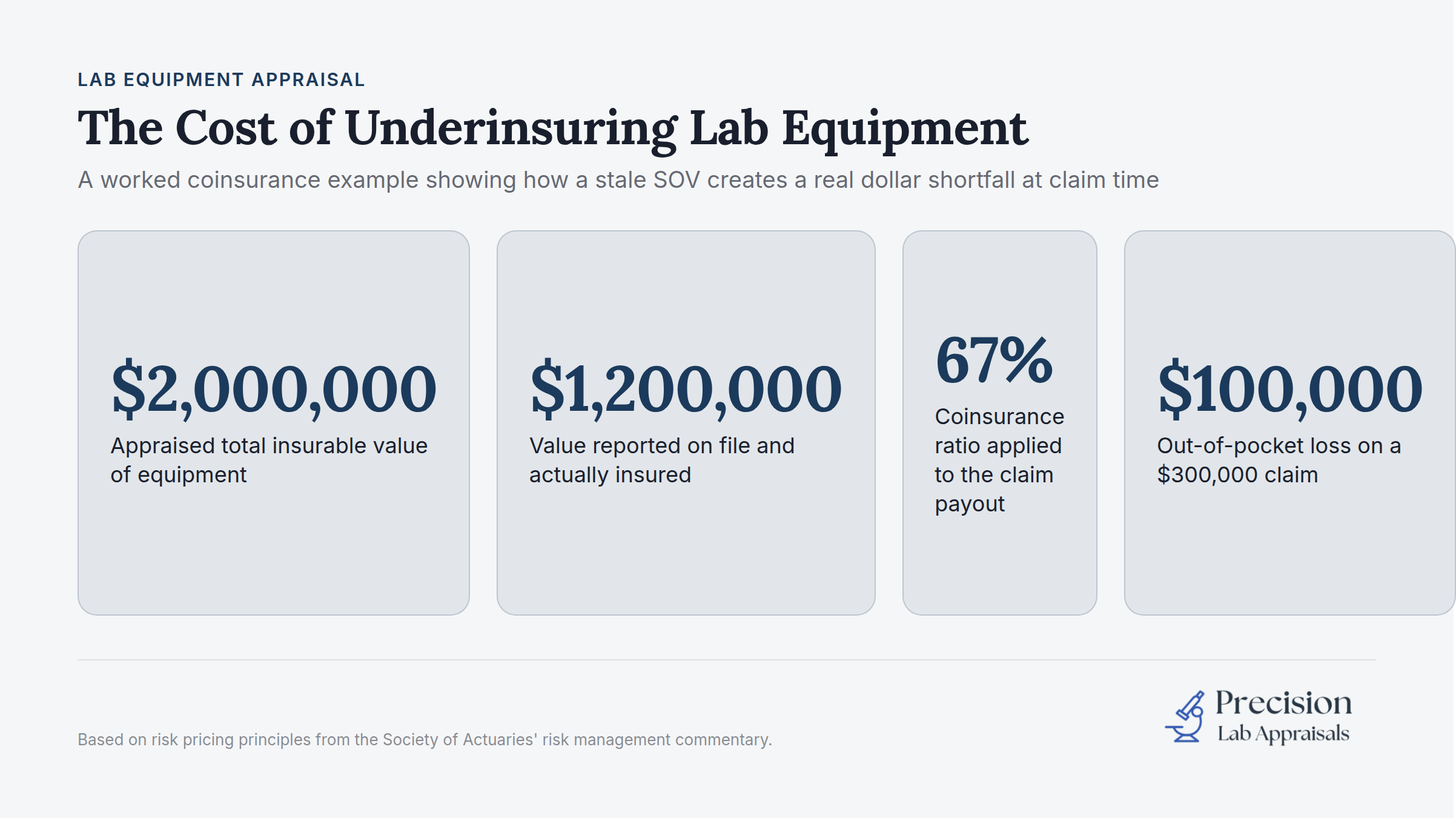
Example: Say a lab's appraised total insurable value (TIV) for its equipment schedule is $2,000,000, but the SOV on file, based on old purchase prices, reports only $1,200,000, and the facility insures to that lower figure. The policy carries a coinsurance clause requiring coverage equal to 90% of value, meaning the facility should be carrying at least $1,800,000 in coverage. Because it only carries $1,200,000, it is insured to just 67% of the required amount ($1,200,000 divided by $1,800,000). If a fire causes $300,000 in equipment damage, the insurer applies that same 67% ratio to the claim, paying roughly $200,000 and leaving the lab to absorb the remaining $100,000 out of pocket, even though the loss was well under both the policy limit and the coverage purchased.
Risk pricing literature published by the Society of Actuaries confirms the broader principle behind this: declared or scheduled values are the primary exposure measure insurers use to price and settle property risk, which is exactly why an inflated or stale number does not just risk overpaying on premium, it risks a real shortfall at claim time (see the Society of Actuaries' risk management commentary). Premiums themselves are also calculated directly off the scheduled value; one university equipment insurance program, for example, publishes a flat rate of $1.43 per $100 of insured value, so a $1,000 instrument costs $14.30 a year to cover (see Stony Brook University's equipment insurance program). Get the value wrong in either direction and you either overpay every year or underrecover on the day it matters.
How Often Should You Update Appraised Lab Equipment Values?
The short answer: before every renewal, and again after any major equipment purchase or disposal. Waiting for a multi-year cycle is how the gap between reported value and true replacement cost grows large enough to trigger a coinsurance penalty.
A workable cadence for most labs and biotech facilities looks like this:
- Before each policy renewal: Refresh the equipment schedule with current replacement cost figures so the SOV reflects present-day pricing, not last year's numbers.
- After a major capital purchase: A new mass spectrometer, bioreactor, or freezer farm should be added to the appraisal and the SOV immediately, not held until the next renewal cycle.
- After equipment disposal or retirement: Removing decommissioned instruments keeps the schedule accurate and avoids paying premium on equipment you no longer own.
- Every 2 to 3 years at minimum, even without major changes: Replacement cost for instruments and cold-chain equipment shifts with manufacturer pricing and market conditions even when your inventory stays static.
Pro tip: Fixed-fee lab equipment appraisals are quoted after scoping the assignment, based on the number of instruments and the depth of analysis required, not on the value of the equipment itself. Typical engagements for a lab equipment schedule run from roughly $695 to $2,200, with larger or more complex facilities scoped separately.
A Practical Checklist Before You Complete Your Lab's Statement of Values
Gathering the right information before you sit down with the SOV form saves a round of back-and-forth with your broker or underwriter. Before completing the equipment line, a lab should have the following on hand:
- A current, appraised replacement cost for each major instrument category: analytical instruments, freezers and cold-chain units, incubators, fume hoods, autoclaves, and bioreactors.
- The physical address and location number for every building or suite where equipment is housed.
- COPE details for each location: construction type, occupancy, fire protection systems, and known exposures.
- A clear statement of valuation basis for every line, replacement cost or actual cash value, matching what the policy requires.
- A record of additions and disposals since the last renewal, so the schedule reflects what the lab actually owns today.
- Supporting documentation for high-value or custom instruments, including model, year, function, and any specialized installation cost.
Key takeaway: The SOV is only as good as the values behind it. An appraised, defensible replacement cost for each equipment category protects the facility from both overpaying on premium and absorbing a coinsurance penalty after a loss.
Getting the equipment line right is less about paperwork and more about keeping your coverage matched to what your lab actually owns. A current appraisal turns a stale asset register into a number an underwriter, and an adjuster, can rely on.
This article is provided for general informational purposes only and does not constitute legal, tax, or financial advice. Readers should consult a qualified insurance professional or attorney regarding their specific circumstances.