
Blog
Lab Equipment Insurance Appraisal: What Documentation You Need After a Loss
A lab equipment insurance appraisal turns a fire, flood, or theft loss into a defensible claim, but only if you can hand your appraiser the right proof of ownership, condition, and value. This guide covers exactly what documentation to gather and how replacement cost and actual cash value affect your settlement.
When a fire sweeps through a hematology lab or a burst supply line floods a molecular diagnostics suite, the equipment loss is only half the problem. The other half is proving what you had, what it was worth, and what it will cost to replace. A lab equipment insurance appraisal builds that proof into a report your insurer can act on, and the records you gather before the appraiser arrives determine how smoothly the claim moves.
Why a Lab Equipment Insurance Appraisal Matters After Fire, Flood, or Theft
When a loss occurs, the burden of proof sits with the policyholder, not the carrier. You have to demonstrate not only what your instruments were worth, but that they existed and were in working condition before the incident. A qualified appraisal accomplishes four things at once: it confirms you carried the right amount of coverage, documents that the property existed, establishes its pre-loss condition, and gives the adjuster an itemized inventory with replacement values they can use to settle the claim.
That last point matters more than most lab managers expect. Adjusters handling a diagnostics lab or research facility often don't have the technical background to independently value a mass spectrometer or a PCR platform, so they lean on a lab equipment appraisal for insurance claims to fill that gap with specific, defensible numbers rather than guesswork.
Replacement Cost Value vs Actual Cash Value for Lab Instruments
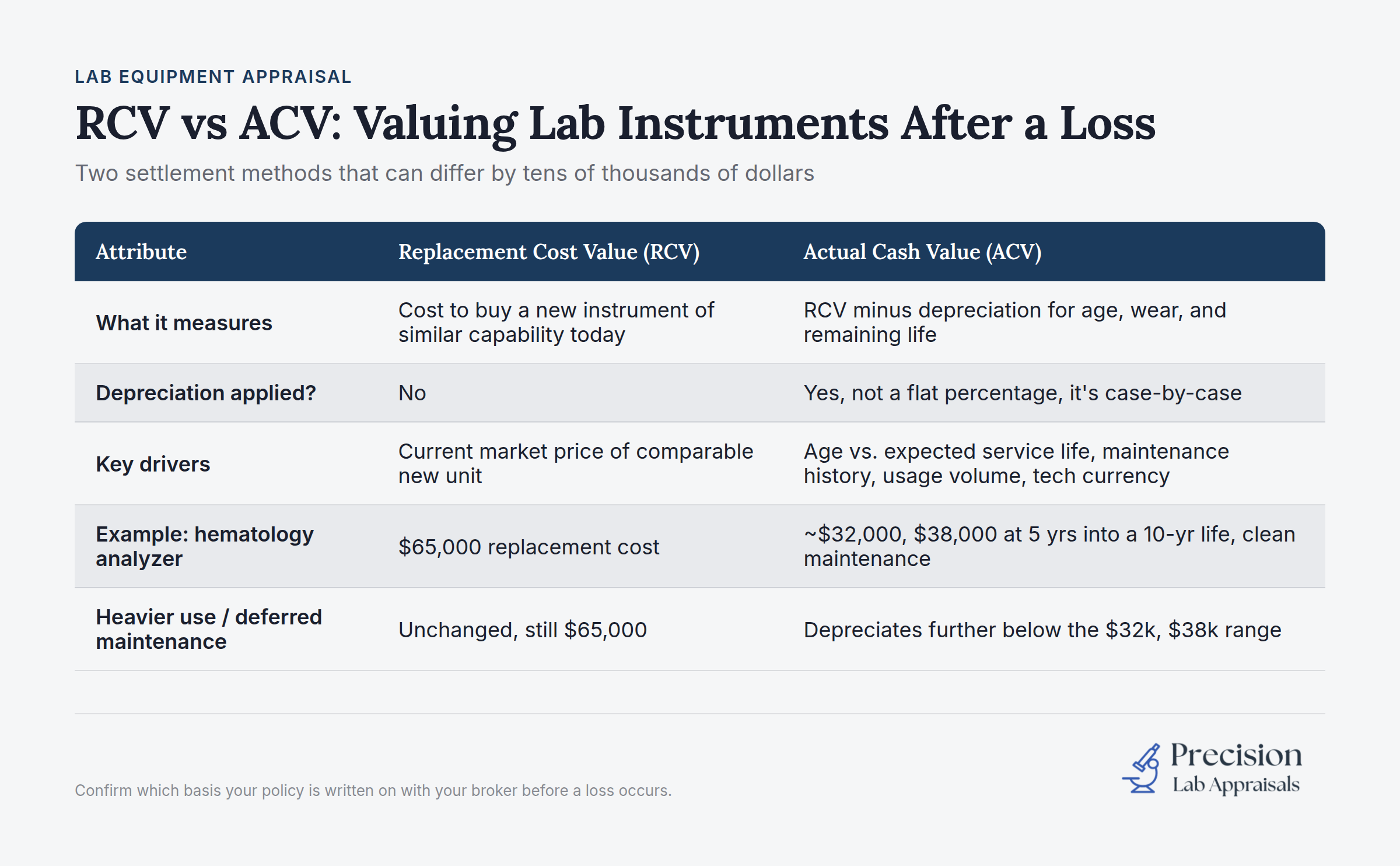
Most commercial property policies settle equipment losses using one of two valuation methods, and the difference can swing a settlement by tens of thousands of dollars. Replacement cost value (commonly shortened to RCV after its first use) is what it would cost today to buy a new instrument of similar capability. Actual cash value (commonly shortened to ACV after its first use) starts from that same replacement cost and then subtracts depreciation for age, wear, and remaining useful life.
For lab equipment, depreciation isn't a flat percentage. An appraiser weighs the instrument's age against its expected service life, its maintenance history, how heavily it was utilized, and whether the platform is still in current production or has been superseded by newer technology. A five-year-old chemistry analyzer that was serviced on schedule and ran moderate volumes depreciates differently than an identical unit that ran continuously at high throughput with gaps in its service history.
Example: A hematology analyzer with a $65,000 replacement cost, five years into an expected ten-year service life with a clean maintenance record, might carry an actual cash value closer to $32,000 to $38,000 after depreciation. The same model with deferred maintenance and heavier use could depreciate further. Your policy's stated valuation basis determines which figure the appraisal ultimately needs to support, so knowing whether your coverage is written on a replacement cost or actual cash value basis before a loss happens is worth confirming with your broker. Our guide comparing fair market value and liquidation value walks through how these valuation premises diverge further when equipment is being sold rather than replaced.
What Your Appraiser Needs From You: A Documentation Checklist
An appraiser cannot support a replacement cost or depreciation opinion out of thin air. Every figure in the report has to trace back to something concrete: an invoice, a service record, a photograph, a serial number. Commercial property claim guidance consistently points to the same categories of proof for machinery and equipment losses, and lab instruments are treated no differently than any other capital equipment.
Before your appraiser's first call, gather the following:
- Proof of ownership: Purchase invoices, lease agreements, or asset register entries showing what each instrument cost and when it was acquired. Commercial claims guidance identifies purchase invoices, asset registers, and depreciation schedules as the standard proof of ownership and value insurers expect on equipment claims, alongside valuation certificates.
- Equipment identification: Make, model, and serial number for every instrument, plus its location within the facility. Detailed lists that show the cost price and acquisition date of each damaged item are a standard requirement in commercial property claim processes for machinery and equipment losses.
- Maintenance and service records: Logs showing regular servicing, repairs, and calibration history. These records demonstrate proper care and support an accurate read on remaining useful life, which is exactly what industrial and warehouse claims guidance points to when arguing for a stronger replacement position.
- Calibration certificates: Documentation showing the instrument met its performance specifications close to the date of loss, which supports both condition and functional value.
- Pre-loss and post-loss photographs: Images of each instrument, including any visible nameplate or serial tag, taken before the incident if available and immediately after.
Pro tip: Keep a standing equipment file for every major instrument, updated whenever it's serviced. Rebuilding this documentation from memory after a fire or flood is far harder than pulling an existing folder.
Watch out: Insurers and adjusters routinely ask for a sworn statement of claim, an affidavit of loss, and a detailed inventory of both damaged and undamaged property in addition to equipment-specific records. General claims documentation guidance for policyholders recommends collecting photos, receipts, serial numbers, and pre-loss images well before a loss occurs, not after.
What the Appraisal Report Itself Documents
Once the underlying records are in hand, the appraisal report translates them into a structured opinion of value the insurer, adjuster, or court can rely on. A lab equipment appraisal prepared for an insurance claim typically includes an itemized inventory of every affected instrument, research supporting current replacement cost for each item, and a condition and depreciation analysis explaining how the appraiser arrived at actual cash value where the policy calls for it.
The report also documents its own scope of work: what was inspected, what records were reviewed, what assumptions were made, and what valuation premise was used. This is prepared in accordance with USPAP, the Uniform Standards of Professional Appraisal Practice published by The Appraisal Foundation, so the methodology holds up to scrutiny from adjusters, accountants, or a court if the claim is ever disputed.
Proving the Loss When Equipment Is Destroyed and Can't Be Inspected
A total loss creates a specific problem: there's nothing left to physically inspect. When a chemistry analyzer or an autoclave is destroyed beyond recognition, the appraiser has to reconstruct its identity, condition, and value entirely from records rather than from an on-site examination.
This is where the documentation gathered before the loss becomes irreplaceable. Purchase invoices and asset registers establish that the instrument existed and what it cost. Maintenance logs and calibration certificates establish its condition immediately before the incident. Photographs taken during routine operations, even informal ones from a lab notebook or a facilities audit, can substitute for a physical inspection that's no longer possible. Maintenance history and equipment specifications are exactly the kind of evidence public adjusters and claims consultants point to when reconstructing a destroyed asset's value for a manufacturing or laboratory facility.
Key takeaway: The strength of a total-loss claim is set months or years before the loss happens, by whether the lab kept clean records. An appraiser can build a defensible opinion of value from good documentation, but no appraiser can invent proof that was never created.
When You and Your Insurer Disagree: The Policy's Appraisal Clause
Most commercial property policies include an appraisal provision (sometimes called an appraisal clause) as a built-in resolution path when the insured and the carrier can't agree on the amount of loss. Under this provision, each side selects its own appraiser, the two appraisers select a neutral umpire, and the resulting agreement between any two of the three parties sets the settlement amount.
A well-documented, USPAP-compliant appraisal carries more weight in that process than an informal estimate. If your initial claim documentation was thin and the insurer's adjuster values your equipment well below what you believe it's worth, invoking the appraisal clause with a properly supported report is often more productive than a prolonged dispute over the adjuster's own numbers.
Get the Paper Trail Right Before You Need It
A lab equipment insurance appraisal is only as strong as the records behind it. Invoices, asset registers, serial numbers, maintenance logs, calibration certificates, and photographs turn an opinion of value into a documented, defensible claim, whether you're negotiating a partial loss or proving a total one. Building that file now, before an incident, is the difference between a claim that settles on your numbers and one that drags on for months.
If your lab is preparing for a claim or simply wants its equipment properly valued and documented ahead of one, request a lab equipment appraisal and our team will scope the engagement around your instruments and your policy's requirements.
This article is provided for general informational purposes only and does not constitute legal, tax, or financial advice. Readers should consult a qualified attorney or insurance professional regarding their specific circumstances.