
Blog
Desktop vs On-Site Lab Equipment Appraisals: Which Do Lenders and Courts Accept?
A desktop lab equipment appraisal can satisfy lenders, the IRS, and courts when it's built on solid documentation, but some engagements still call for a physical inspection. This guide explains the difference and who accepts which.
When a client asks whether we need to walk into their lab or whether photographs and records will do, the honest answer is: it depends on what the appraisal is for. A desktop lab equipment appraisal relies on equipment lists, serial numbers, photographs, and maintenance records instead of a physical site visit, and in many cases that's exactly what a lender, insurer, or tax filing requires. Our lab equipment appraisal services are completed online in most cases, with on-site inspections arranged when the complexity of the equipment or the intended use calls for direct verification.
What Is a Desktop Lab Equipment Appraisal?
A desktop appraisal is a USPAP-compliant valuation developed from records rather than an in-person inspection. The appraiser reviews the equipment list, photographs, and supporting documentation, then applies standard valuation methodology (cost, market, or income approach) to reach a defensible conclusion of value.
A properly scoped desktop appraisal still requires substantial documentation. At minimum, we typically request:
- A complete equipment list with manufacturer, model, and serial number for each asset
- Purchase dates and original cost, where available
- Current photographs showing the equipment's apparent condition and configuration
- Maintenance, service, and calibration records
- Location and facility information for each item, especially across multiple sites
The difference between a desktop appraisal and a quick verbal estimate is the rigor behind it. A desktop report still names the intended use, the definition of value applied, the scope of work performed, and any assumptions made because a physical inspection did not occur. Without that disclosure, the report is an opinion, not a standards-compliant appraisal.
When Is a Desktop Appraisal Enough?
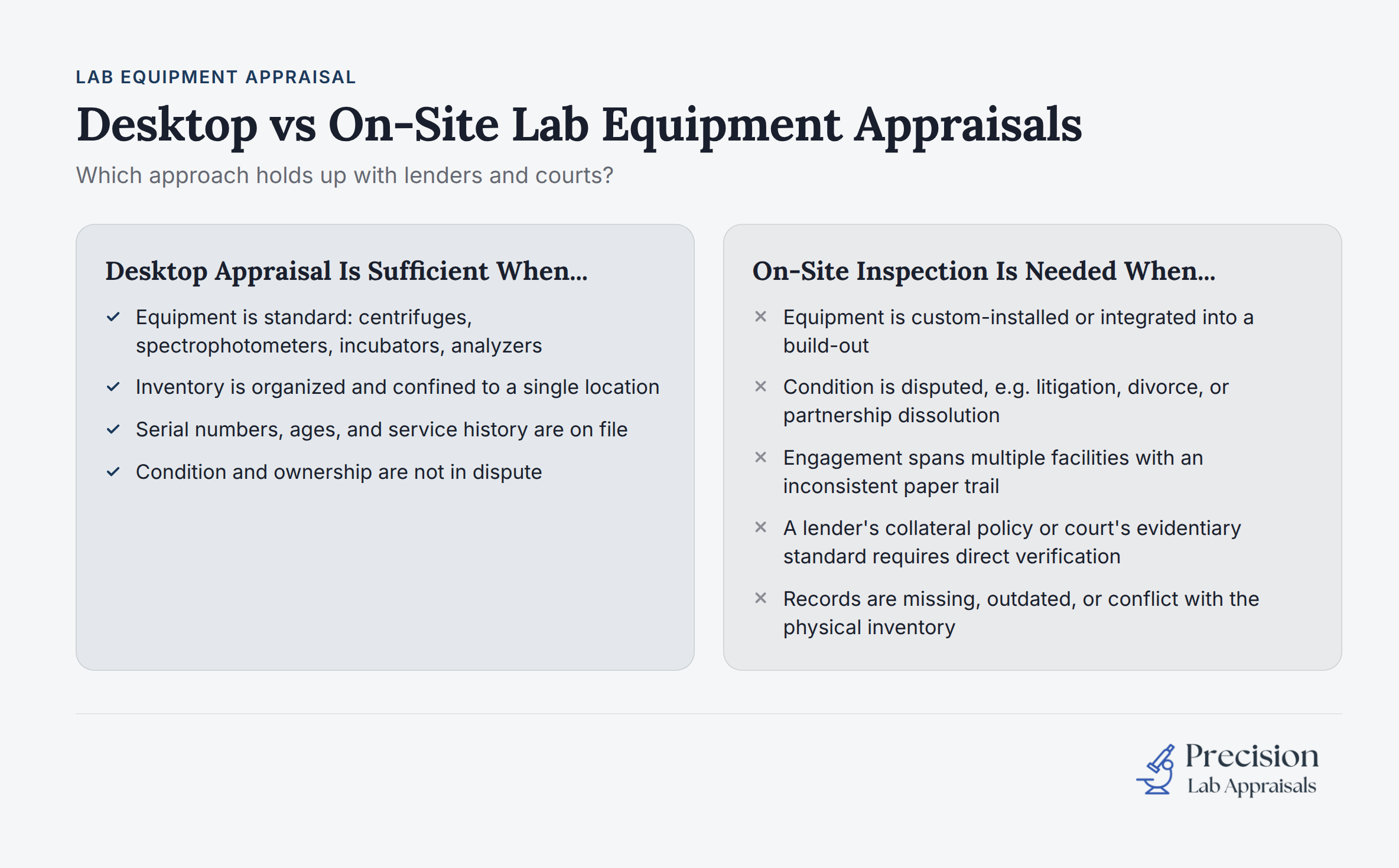
A desktop appraisal is generally sufficient when the equipment is well documented, standard in configuration, and not disputed. It becomes a weaker choice once condition, installation, or completeness are genuinely in question.
Desktop work tends to hold up well for organized, single-location inventories of common lab equipment such as centrifuges, spectrophotometers, incubators, and analyzers where serial numbers, ages, and service history are on file. It's a harder fit when the equipment is highly specialized, heavily integrated into a facility's plumbing or electrical systems, or when ownership and condition are contested.
An on-site inspection becomes the better (and sometimes necessary) choice when:
- The equipment is custom-installed or integrated into a build-out, making photographs insufficient to establish completeness
- Condition is disputed between parties, such as in litigation or a contentious divorce or partnership dissolution
- The engagement spans multiple facilities and the paper trail is inconsistent or incomplete
- A lender's collateral policy or a court's evidentiary standard specifically calls for direct verification
- Records are missing, outdated, or appear to conflict with the physical inventory
Desktop vs On-Site Lab Equipment Appraisals at a Glance
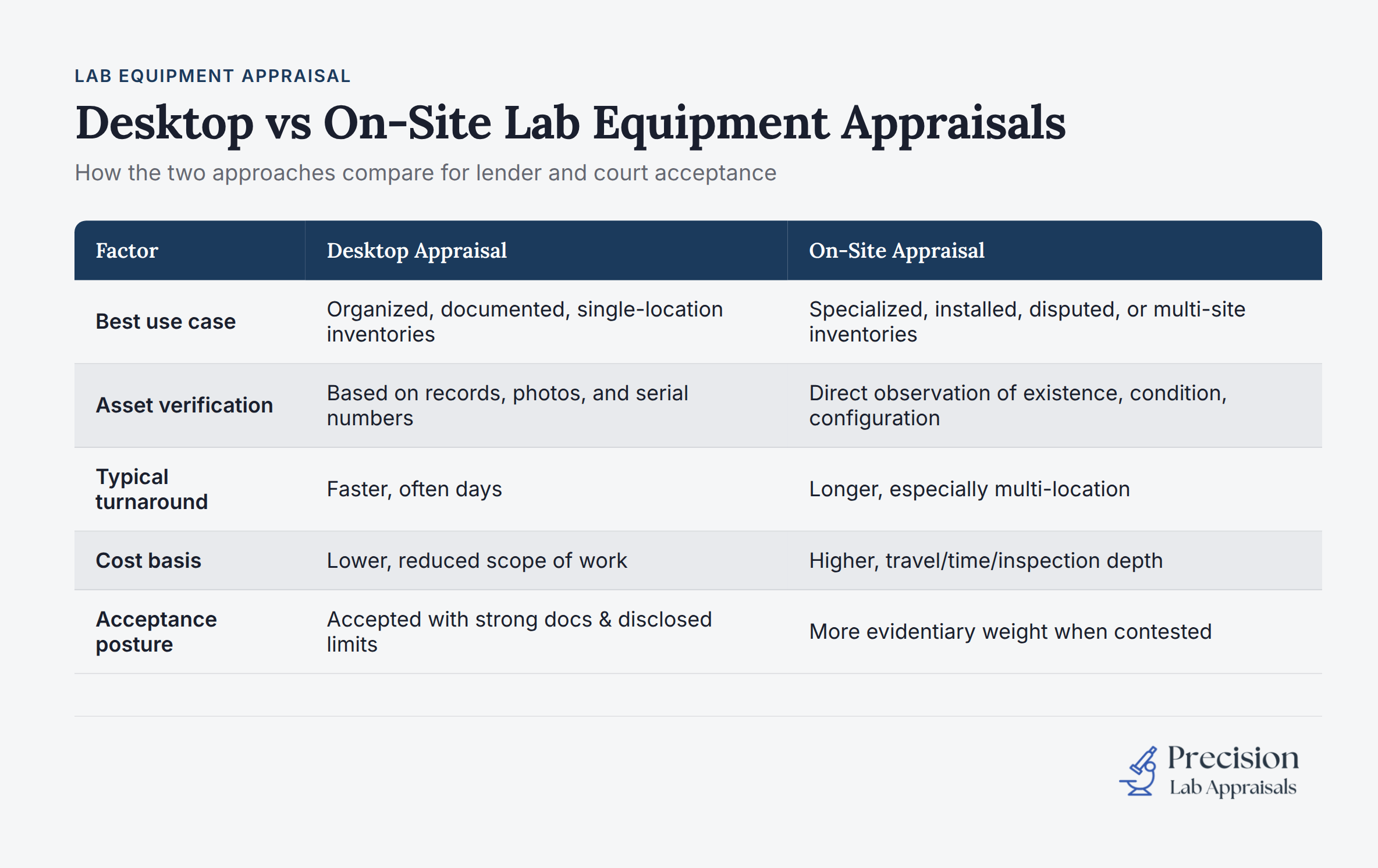
The table below summarizes how the two approaches typically compare across use case, turnaround, and acceptance posture.
| Factor | Desktop Appraisal | On-Site Appraisal |
|---|---|---|
| Best use case | Organized, documented, single-location inventories | Specialized, installed, disputed, or multi-site inventories |
| Asset verification | Based on records, photographs, and serial numbers | Direct observation of existence, condition, and configuration |
| Typical turnaround | Faster, often days rather than weeks | Longer, especially for multi-location engagements |
| Cost basis | Generally lower given the reduced scope of work | Generally higher to account for travel, time, and inspection depth |
| Acceptance posture | Accepted when documentation is strong and limitations are disclosed | Carries more evidentiary weight when condition or existence is contested |
How the IRS Treats Desktop Appraisals
Neither Internal Revenue Code §170(f)(11) nor its related Treasury regulations categorically require an in-person inspection for a qualified appraisal supporting a charitable deduction on Form 8283. What the rule does require is that the appraisal credibly establish the property's description, condition, and value as of the relevant date, which means the documentation behind a desktop appraisal has to do real work.
For donated lab equipment, that usually means photographs taken close to the donation date, service records showing operability, and a clear chain of custody from the donor to the recipient organization. Our guide on what makes an appraisal qualified under IRS Publication 561 walks through the appraiser-qualification and content requirements in more detail. For current IRS guidance on qualified appraisals generally, see IRS.gov.
SBA and Lender Acceptance: 504 vs 7(a)
SBA 504 loans, which rely on the equipment itself as primary collateral, generally expect an on-site inspection because the lender's recovery in a default scenario depends heavily on the physical condition and marketability of the specific assets pledged. SBA 7(a) lenders, by contrast, often accept a desktop appraisal under their own underwriting policy when the borrower's records are complete and the equipment is readily identifiable.
The Federal Register has described situations where a required personal-property appraisal must follow a specific agency form or procedure rather than a generic standards-compliant report, which is a reminder that USPAP compliance alone does not guarantee acceptance where a program or lender policy prescribes its own format. Borrowers should confirm with their lender, before the appraisal is scoped, whether the loan program requires a site visit.
Pro tip: Ask your lender for their collateral appraisal policy in writing before the engagement starts. It's far cheaper to scope an on-site visit up front than to redo a desktop report later because underwriting rejected it.
How USPAP Treats the Inspection Question
USPAP, published by The Appraisal Foundation, does not mandate a physical inspection for every assignment. What it requires is that the scope of work, whatever it is, be sufficient to produce credible results given the intended use. That puts the burden on the appraiser to match the method to the assignment, not on a blanket rule that desktop work is always acceptable or always insufficient.
In practice, this means a desktop appraisal prepared for a well-documented inventory can be just as standards-compliant as an on-site appraisal prepared for a contested one, provided the appraiser discloses the limitations and the underlying evidence supports the conclusion reached. When choosing a lab equipment appraiser, ask directly how they decide between desktop and on-site work and what they'd require to stand behind a desktop conclusion if it were challenged.
How Courts Weigh Desktop Appraisals
Courts generally do not reject an appraisal simply because it was prepared at a desk. The relevant questions are whether the appraiser is qualified, whether the methodology is reliable, and whether the factual inputs can withstand cross-examination.
A desktop appraisal tends to hold up well in matters that are primarily about market value and where the equipment's existence and condition aren't in dispute. It carries less weight in disputes over whether equipment exists, whether it's operational, or whether it has been concealed or misrepresented, because those are exactly the questions a physical inspection is built to answer. In divorce, partnership dissolution, or bankruptcy matters where condition is contested, an on-site inspection generally produces stronger, harder-to-challenge evidence.
What Drives the Fee for Either Approach
Fees for a lab equipment appraisal are quoted as a fixed amount after we scope the assignment, never billed by the hour. What changes the fee is the scope of the work itself: the number of assets and locations involved, the completeness of the records provided, whether the report needs to be IRS-qualified, and how much analysis the assignment requires. A desktop engagement with a clean equipment list is typically less involved than a multi-site engagement that requires travel and physical verification, which is reflected in the fee, not in the condition or value of the equipment itself. Current published ranges for lab equipment appraisals start at $295 for standard reporting and $395 for IRS-qualified reporting, with typical engagements running $695 to $2,200 and complex, multi-location projects reaching $5,000 to $10,000 or more.
Choosing the Right Approach for Your Situation
The real decision isn't desktop versus on-site in the abstract. It's whether the chosen scope of work will produce a credible answer to the question your lender, the IRS, or a court actually needs answered. A documented, single-site inventory of standard lab equipment is usually a good candidate for a desktop appraisal. A disputed, specialized, or multi-location engagement usually isn't, and paying for an on-site visit up front is cheaper than having the report challenged later.
If you're not sure which approach fits your situation, our team can scope the assignment with you before any fee is quoted and recommend whether a desktop or on-site appraisal will hold up for your specific intended use.
This article is provided for general informational purposes only and does not constitute legal, tax, or financial advice. Readers should consult a qualified attorney or CPA regarding their specific circumstances.